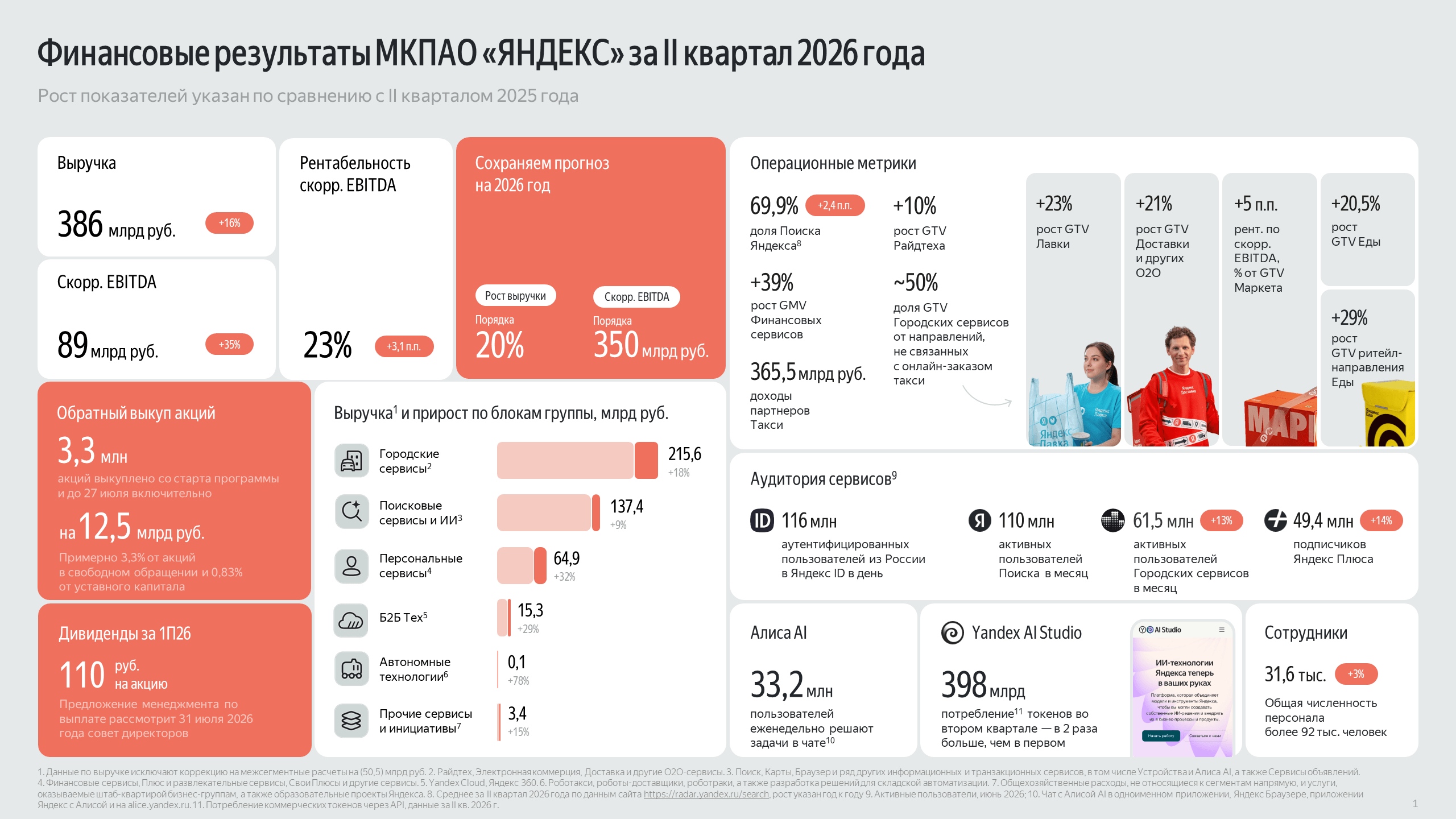
Yandex’s financial results for the second quarter of 2026 confirm the company’s steady growth across virtually all key business areas. For the market, this is another indication that its focus on artificial intelligence, ecosystem services, and cloud technologies continues to deliver tangible results.
During the quarter, the company’s revenue reached RUB 386.3 billion, up 16% year over year. Adjusted EBITDA rose by 35% to RUB 89 billion, while adjusted net income surged by 56% to RUB 48 billion.
It was also announced that on July 31, 2026, the Board of Directors will consider a proposal to pay a first-half dividend of RUB 110 per share.
Artificial Intelligence Is Becoming One of the Main Growth Drivers
One of the most interesting business areas remains the Search Services and AI cluster, which combines search, classified advertising services, devices, and the Alice AI ecosystem.
During the quarter, this segment generated RUB 137.4 billion in revenue, up 9% from the same period last year. Adjusted EBITDA reached RUB 63.7 billion, an increase of 12%.
The development of artificial intelligence has been particularly notable:
- Alice AI’s weekly audience grew by 39% quarter over quarter, reaching 33.2 million users.
- AI-generated answers now accompany 42% of search queries on Yandex.
These figures demonstrate that generative AI is gradually becoming a standard part of the user experience rather than a separate experimental technology.
E-Commerce Becomes Profitable for the First Time
One of the quarter’s most significant developments was the E-Commerce division—comprising Market, Lavka, and Eda—reaching break-even.
Overall, the Urban Services segment, which includes e-commerce, ride-hailing technology, delivery, and other online-to-offline services, increased its revenue to RUB 215.6 billion, representing 18% year-over-year growth.
The segment’s adjusted EBITDA surged by 168% to RUB 34.4 billion.
The E-Commerce business itself recorded positive adjusted EBITDA for the first time, amounting to RUB 401 million.
According to the company, the deep integration of services within the ecosystem played a key role.
Today, almost every second home delivery from Yandex Market is placed together with products from Lavka, while around 11% of all Lavka deliveries include marketplace goods.
This model allows one service to increase another’s turnover while simultaneously reducing customer acquisition and logistics costs.
Additional contributions to profit growth came from:
- Improved efficiency in the RideTech business.
- A significant improvement in Yandex Market’s financial performance.
- A more than twofold increase in Yandex Eda’s EBITDA.
The Subscription and Financial Services Ecosystem Continues to Grow
The Personal Services segment, which combines Plus, entertainment products, and financial services, delivered one of the company’s highest growth rates.
The segment’s revenue reached RUB 64.9 billion, an increase of 32%.
Of this amount:
- RUB 29.5 billion came from financial services.
- RUB 34.9 billion came from entertainment services and the Plus subscription.
The number of Yandex Plus subscribers grew by 14.4%, reaching 49.4 million.
The segment’s adjusted EBITDA amounted to RUB 2.5 billion, up 20%, while the total turnover of its financial services rose to RUB 351 billion, representing 39% growth.
Cloud Technologies and Enterprise Solutions Continue to Accelerate
The B2B Tech segment, which combines Yandex Cloud, Yandex 360, and other enterprise services, also demonstrated strong growth.
Revenue reached RUB 15.3 billion, rising by 29%, while adjusted EBITDA increased by 43% to RUB 3.7 billion.
The company attributes these results to a growing share of higher-margin PaaS and SaaS solutions, improved operational efficiency, and strong demand among major corporate customers for artificial intelligence and information security services.
Another indicator of growing interest in the company’s AI products is the use of the Yandex AI Studio platform.
During the quarter, 398 billion commercial tokens were consumed through its API. This is:
- Twice as many as in the first quarter of 2026.
- 70% more than during the whole of 2025.
Robotics Is Gradually Entering Large-Scale Commercial Use
The company continues to actively develop autonomous delivery.
As of July 2026:
- The delivery robot fleet exceeded 1,000 rovers.
- The robots were already operating in 10 cities.
- They completed more than 260,000 deliveries during the second quarter.
In addition, Yandex expects to put 100 robotaxis on the streets of Moscow by the end of 2026, marking the next stage in scaling autonomous transportation.
KIRANO’s Conclusion
The second-quarter results highlight several important trends in the Russian IT market.
First, artificial intelligence is no longer an experimental business area and is already having a direct impact on the financial performance of major technology companies.
Second, the ecosystem model continues to prove its effectiveness: integrating different services makes it possible to reduce customer acquisition costs, optimize logistics, and improve overall business profitability.
Third, the enterprise market is investing increasingly heavily in cloud technologies, artificial intelligence services, and information security, as demonstrated by the accelerating growth of the B2B Tech segment.
For businesses, this means that competitiveness increasingly depends not only on the digitalization of processes, but also on the ability to bring different digital products together into a unified ecosystem. Integration, automation, and the use of AI are now becoming some of the key factors driving companies’ long-term growth.
Recommended articles

CRM System for Business: Why It Is Important and How It Helps Increase Sales
CRM System for Business: Why It Is Important and How It Helps Increase Sales What Is a CRM System and Why Does Your Business Need It? A CRM system (Customer Relationship Management) is a tool designed to manage customer

The Story Behind KIRANO Marketing Agency: From a Passion Project to an International IT Company
The Story Behind KIRANO Marketing Agency: From a Passion Project to an International IT Company Behind every successful company lies a story. A story of decisions, challenges, sleepless nights, and people who once chose

What Marketing Metrics Should You Track?
What Marketing Metrics Should You Track? Marketing without analytics turns into guesswork. A company may run advertising campaigns, manage social media accounts, send email newsletters, and promote its website, but witho
2017 - 2026 © KIRANO